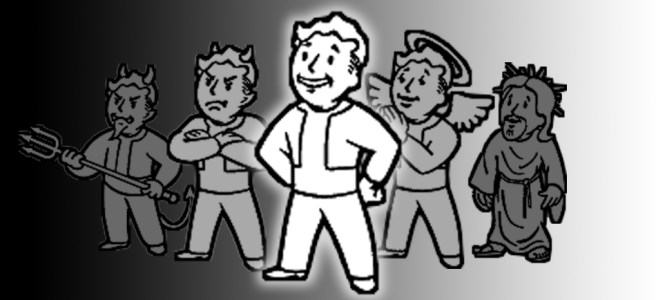
A discussion on in-game morality and why playing the evil route never seems enjoyable to me. (May contain plot spoilers for various video games)
Picture the scene: you pick up an RPG and it offers moral choices to pick from as you progress. These choices shape your game from its story to accessible characters and items. How exactly do you play it, especially knowing that certain choices lock you out from certain
For me, I’ve never found much enjoyment in playing a game’s evil, treacherous paths. It might offer the occasional bit of catharsis from a run of being a goody two-shoes but, when given the choice to be compassionate and avoid violence I’ll often take it over the alternative.
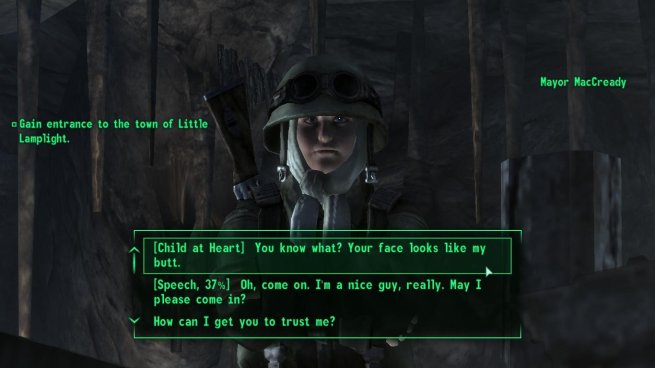
It’s nice to see that a lot of games do offer both takes on a storyline. It creates divergent plots with a lot of replay value in finding all the different responses and seeing just how far you can take things. Admittedly, though, few games actually take a neutral approach to their storylines. In fairness, stories of characters doing whatever they can to survive with mixed moral reproach are a little harder to weave in terms of who the hero or villain truly is. You’d think, as the main protagonist, that you’re the hero of the story regardless of where your actions take you. History will be written by the victors and, since the goal of every video game is to win, your actions should justify your means of achieving it. With that said, though, I still struggle to find sustained enjoyment in being the bad guy in these stories.
From a principles standpoint, I’d like to think that I’m a fair and conscientious individual. Even though video games are purely fantasy and ones actions on them does not necessarily reflect ones actions in real life, I still try to act as I would in reality given the options available to me in the game. If a character has a speech tree that has “Let’s not be too rash,” and “Fuck you! You’re gonna die, bitch!” I’m more likely to favour the former option purely due to my nature as a player. I don’t understand why I favour being heroic or benevolent in these games. Perhaps it’s down to a history of playing games with distinct heroes and that heroes are much easier to relate to than villains in most cases. Whatever the reason, being bad can often turn me off an experience more than being the good guy.
That’s not to say that being the good guy is fun. As I said earlier, there is catharsis to draw from devious activities especially if you can get away with it. Fallout New Vegas was littered with incidents of pickpocketing, general theft and occasional cold-blooded murder but, as long as it was balanced with good deeds to the community, my Karma would rarely dip below neutral. At one stage, I had murdered an encampment of prisoners, two towns full of people and stolen items worth thousands of bottlecaps, yet my karma level remained strictly paragon. My actions were justified purely because the balance between good and evil was kept squarely in the white. Going full-on villain can get somewhat stale though, despite the initial high, since all nefarious actions largely involved murder and extortion. The depth of storylines were traded entirely for the calculated murder of everyone on the Mojave.
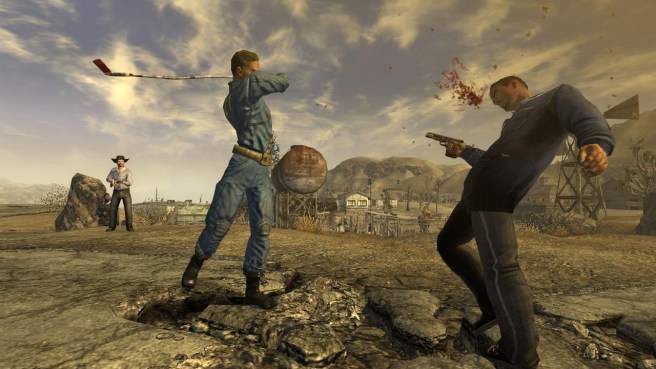
In the end, a lot of these stories do follow the same vague path towards the end. The concept of moral choice is usually a vehicle for the plot to advance but rarely changes the outcome drastically in the grand scheme of things. Fallout New Vegas will always climax at Hoover Dam regardless of who makes it there in the end or by what means. Very few games really take the concept of the moral choice and give extremely different routes to take, most likely due to the complexity of its implementation. It’s usually easier to tell a linear story with differing character attitudes based on your disposition rather than making different story arcs based on your actions.
The one game to truly exploit the story of good versus evil actions in video games for me was Undertale. Undertale was an RPG that, in a very unique twist, had you try to make friends with enemy creatures rather than killing them. At the time, this was revolutionary but the extraordinary thing was that it was incredibly fun. Battles were usually humourous with more personality between exchanges. You progressed through the underworld by pacifying threats rather than destroying them and it was incredibly fun.
Undertale did still allow you to kill enemies the traditional way to level up your character and gain XP. You can even go as far as to kill every single thing in the underworld to level up your character quicker. This, however, is where the game turns from colorful RPG to a dismal, dark experience.
It’s worth noting that the game never outwardly punishes you for killing creatures but it doesn’t really reward you either, to an extent. Battles don’t end triumphantly, they just stop and you move on. After killing everything, random encounters show you that “Nobody came,” and the music suddenly becomes dirge-like and emotionless. The game is punishing you by not punishing you but taking away what made the place fun and interesting… because you took it away first.
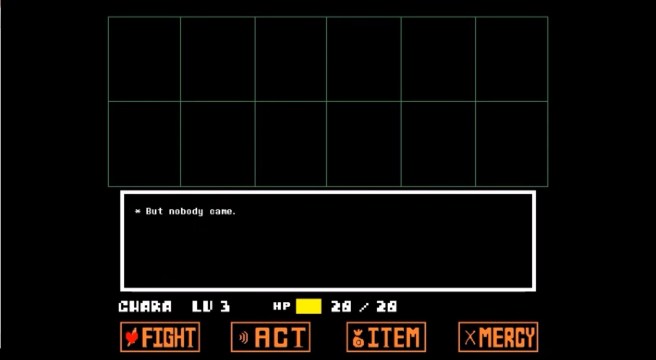
The aptly coined “Genocide run” is not fun, but that’s because it isn’t supposed to be. In an extraordinarily subtle statement to the player, Undertale puts across the concept that destroying everything isn’t supposed to be fun. You took a colourful adventure and made it about nothing more than destruction and personal gain. Why should the game encourage you to be this way? The game almost takes glee in its warnings to you as a player for going down this route. Characters warn you to change your mind; have mercy; spare even one of them to change the path you’re on. Refuse and the game ends not with a triumphant note or credits but with the destruction of everything in the game, including the game itself.
Fortunately, the game is resettable after this so that you can either atone for your sins or maybe take a different, better path. However, in a truly genius move, no matter what ending you pick after genocide, the game will never let you forget what you did before.
It’s worth noting that, if you do change your mind mid-genocide, the game will comment on it but will not outright punish you for it. Rather, it simply explains to you calmly that you probably had reasons to do what you did, but choosing the right path a bit late is still an okay thing to do. It’s actually a mature way of discussing the nature of morality and the decisions we make as players. Rather than beating us about the head, it simply accepts your choices but suggests an alternative. It’s masterfully done and carries a moral impact that few games before or since have managed to accomplish with bigger budgets and better graphics. (Not to say that the game doesn’t look amazing at all.)

Maybe it has something to do with my own moral compass that I can’t act in malice or cruelty in these games without some forcing on my part. I know I’m not perfect, though. I still play shooters daily, I’ve played all the Grand Theft Auto games and I know that the more morally ambiguous catalog of games are still very fun. Stories will always need heroes though and, while some may be less justifiable than others, I imagine I’ll always try to be the stalwart hero I aspire to be.
Then again, it can be fun to be the villain sometimes…


 EDOOWINNIE